
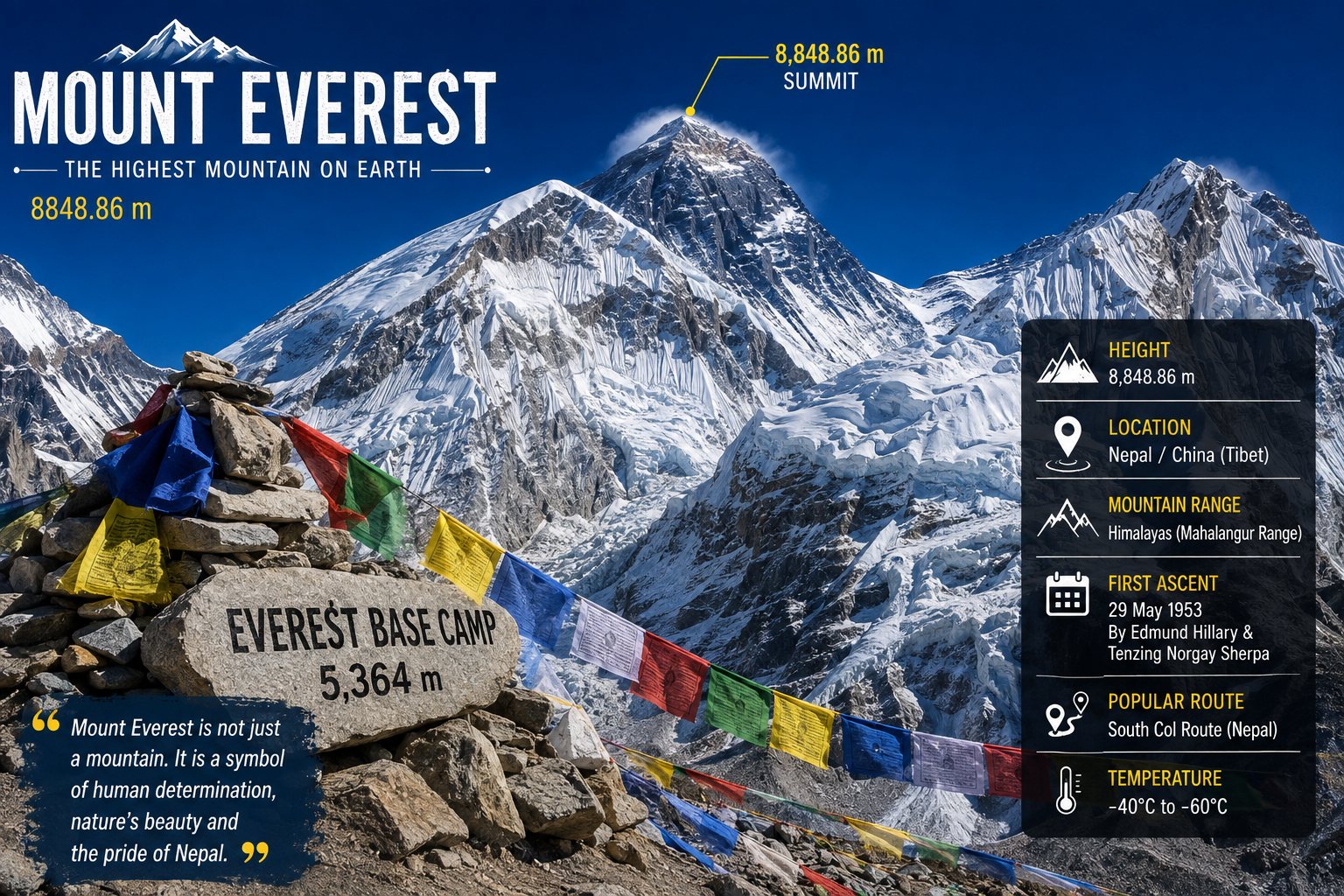
Mount Everest. The Highest Mountain on Earth
Mount Everest is the highest mountain in the world, standing at 8,848.86 meters (29,031.7 feet) above sea level. It lies on the border between Nepal and the Tibet Autonomous Region of China. Known as Sagarmatha in Nepal and Chomolungma in Tibet, Everest is one of the most recognized natural landmarks on Earth.
Every year, thousands of climbers, trekkers, researchers, photographers, and adventure enthusiasts visit the Everest region. While only a limited number reach the summit, the mountain remains a symbol of determination, courage, and human achievement.
Location
Mount Everest is part of the Mahalangur Himal subrange of the Himalayas.
Country: Nepal and China
Province (Nepal): Koshi Province
National Park: Sagarmatha National Park
Nearest Airport: Lukla Airport
Nearest Town: Namche Bazaar
Height
The official height of Mount Everest is 8,848.86 meters.
This height was jointly announced by the governments of Nepal and China in 2020 after a modern scientific survey.
Names of Mount Everest
Sagarmatha, Nepali name meaning "Head of the Sky."
Chomolungma, Tibetan name meaning "Goddess Mother of the World."
Mount Everest, Named after Sir George Everest, a British surveyor.
Geological Formation
Mount Everest was formed approximately 50 to 60 million years ago when the Indian tectonic plate collided with the Eurasian plate.
Even today, the mountain continues to rise by a few millimeters each year due to ongoing tectonic movement.
Climate
Winter temperatures can drop below minus 40°C.
Wind speeds often exceed 160 km/h.
The climbing season is usually during April and May, when weather conditions become relatively stable.
Flora and Fauna
The Everest region is home to diverse wildlife including:
Snow Leopard
Red Panda
Himalayan Tahr
Musk Deer
Danphe (Himalayan Monal)
Various alpine plants and rhododendron forests
History of Climbing
For decades, Everest remained unclimbed despite numerous attempts.
On 29 May 1953, Sir Edmund Hillary of New Zealand and Tenzing Norgay Sherpa successfully reached the summit for the first time in recorded history.
Since then, thousands of climbers from around the world have reached the top.
Major Climbing Routes
South Col Route from Nepal
North Ridge Route from Tibet
The Nepal route is the most popular because it offers better logistics and support.
Risks of Climbing Everest
Extreme altitude sickness
Avalanches
Crevasses
Frostbite
Strong winds
Low oxygen levels
Rapid weather changes
Despite modern equipment, Everest remains one of the world's most dangerous mountains.
Tourism Importance
Mount Everest contributes significantly to Nepal's tourism industry.
It creates employment opportunities for:
Sherpa guides
Porters
Hotel owners
Travel agencies
Helicopter operators
Mountain rescue teams
Local businesses
Environmental Challenges
Increasing waste from climbers
Melting glaciers due to climate change
Overcrowding during climbing season
Pressure on local ecosystems
Nepal has introduced waste management policies requiring climbers to bring back garbage from the mountain.
Interesting Facts
Everest grows a few millimeters taller every year.
More than 6,000 successful summits have been recorded.
The summit receives one third of the oxygen available at sea level.
The first successful ascent occurred in 1953.
Sagarmatha National Park is a UNESCO World Heritage Site.
Why Mount Everest Matters
Mount Everest is more than the world's tallest mountain.
It represents scientific research, environmental awareness, international tourism, cultural heritage, and the extraordinary determination of people who attempt to climb it.
For Nepal, Sagarmatha is a national symbol that attracts visitors from every corner of the world and contributes significantly to the country's economy.